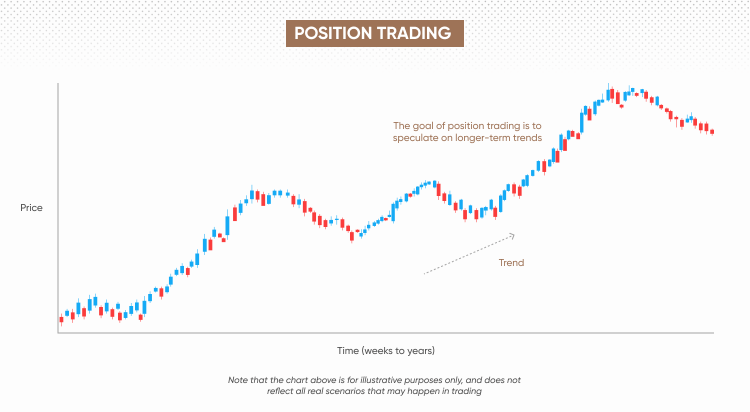
Position trading is a long-term strategy where traders hold positions for weeks, months, or even years. Instead of reacting to short-term fluctuations, position traders focus on capturing major market trends. While it shares similarities with investing, the key difference is that position traders can go both long and short, whereas traditional investors generally only buy and hold.
Among all trading approaches, position trading involves the longest time horizon.
Its advantages include reduced market noise, fewer trades to manage, and the potential to capture larger, more sustained market moves.
Highlights
Involves holding trades for months or years
Similar to investing but allows short selling
Applicable across forex, stocks, indices, commodities, and crypto
Position Trading vs. Other Strategies
Position trading
Day trading
Swing trading
Time frame Long-term
Time frame Short-term
Time frame Medium-term
Holding period Months to years
Holding period Within a day
Holding period Days to weeks
Day trading focuses on intraday opportunities, with positions opened and closed in the same day, requiring higher attention and capital for smaller but frequent gains.
Swing trading, by contrast, aims to profit from moves over several days or weeks, filling the gap between day trading and position trading. Position trading takes over where swing trading leaves off, targeting larger trends and longer horizons.
Want to improve your trading mindset? Talk to an expert at Imperial Strategies today and start mastering your trading psychology.
Why Choose Position Trading?
Reduced frequency of trades – Less market monitoring, allowing more flexibility.